
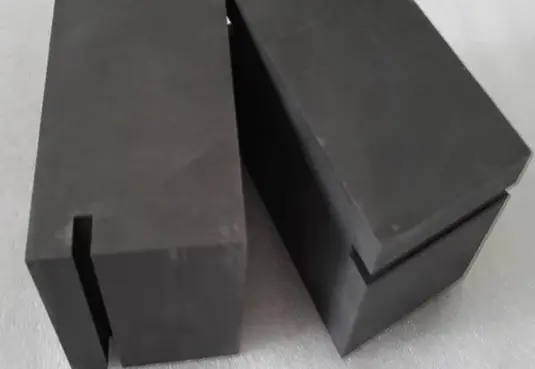
Isostatic graphite is a high-performance synthetic graphite material made through an isostatic pressing process. It is valued for its fine grain structure, uniform physical properties, high purity, thermal stability, and excellent machinability.
Compared with conventional extruded or vibration-molded graphite, Isostatic Pressing Graphite offers more consistent properties in different directions. This makes it a preferred material for demanding industrial applications where precision, reliability, and resistance to high temperatures are essential.
How Is Isostatic Graphite Made?
The production of isostatic graphite starts with carefully selected carbon raw materials, usually fine coke powders and a binder. These ingredients are mixed, milled, and prepared to achieve a controlled particle-size distribution.
The mixture is then shaped through a cold isostatic pressing process. Unlike one-directional pressing, cold isostatic pressing applies pressure uniformly around the material. The powder compact is placed in a flexible mold and subjected to high fluid pressure from all directions.
This uniform pressure helps create a dense, homogeneous graphite precursor. After pressing, the material is baked to carbonize the binder and then graphitized at very high temperature. Depending on the grade, additional purification and machining stages may follow.
What Does “Isostatic” Mean?
The term “isostatic” refers to equal pressure applied in every direction. This production method helps reduce directional differences in the finished material.
Extruded graphite is pushed through a die, which can create a preferred grain orientation. Isostatic graphite has a more uniform, or isotropic, structure. As a result, many of its mechanical, thermal, and electrical properties are more consistent regardless of the direction in which the material is machined or loaded.
Key Properties of Isostatic Graphite
The exact performance of a grade depends on its formulation and manufacturing process, but high-quality Isostatic Pressing Graphite commonly offers:
- Fine and uniform grain structure
- High bulk density
- Good mechanical strength
- High electrical conductivity
- High thermal conductivity
- Low thermal expansion
- Strong resistance to thermal shock
- High-temperature stability in controlled environments
- Good chemical resistance in many applications
- Easy precision machining
- Potential for very high purity
SGL Carbon notes that isostatic graphite is generally among the finest-grain forms of artificial graphite and is designed for applications where standard fine-grain graphite may not provide sufficient mechanical performance. SGL Carbon: SIGRAFINE Isostatic Graphite
Why Fine Grain Structure Matters
Fine grain structure supports better surface finish, dimensional accuracy, and detailed machining. This is especially important for graphite electrodes, semiconductor components, molds, and fixtures with narrow slots, sharp corners, or complex geometry.
Fine-grain isostatic graphite can also provide more uniform electrical discharge characteristics, which is valuable in electrical discharge machining, or EDM.
Common Applications of Isostatic Graphite
EDM Electrodes
EDM uses electrical sparks to machine hard metals and complex shapes. Isostatic graphite is widely used for EDM electrodes because it machines accurately, conducts electricity well, and can produce fine details.
Semiconductor and Solar Manufacturing
High-purity graphite components are used in crystal-growth furnaces, thermal fields, wafer-processing equipment, and other high-temperature semiconductor applications. Low impurity levels and stable dimensions are important in these environments.
Metallurgy and Continuous Casting
Isostatic graphite can be used in molds, dies, crucibles, ladles, degassing components, and continuous-casting systems. Its thermal stability and resistance to thermal shock make it suitable for many metal-processing operations.
High-Temperature Furnaces
Graphite heaters, insulation components, sintering fixtures, furnace supports, and thermal-processing parts may be made from isostatic graphite. In inert or vacuum environments, graphite can perform effectively at elevated temperatures.
Glass, Chemical, and Mechanical Applications
The material is also used in glass-handling components, chemical-industry parts, mechanical seals, bearings, and corrosion-resistant equipment. Selection should always consider the specific chemical environment and operating temperature.
Isostatic Graphite vs. Extruded Graphite
The main difference is the forming process.
Extruded graphite is often economical and well-suited to long shapes such as rods, tubes, and electrodes. However, its properties may vary with grain direction.
Isostatic graphite is typically more uniform and finer-grained. It is often selected for high-precision, high-purity, or high-reliability applications. Its production process is more specialized, so it may cost more than standard extruded grades.
Important Selection Factors
When choosing Isostatic Pressing Graphite, buyers should evaluate the actual requirements of the end use. Key data may include:
- Average grain size
- Bulk density
- Electrical resistivity
- Thermal conductivity
- Flexural and compressive strength
- Ash content or purity level
- Porosity
- Coefficient of thermal expansion
- Maximum service temperature
- Oxidation environment
- Required machined dimensions and tolerances
A high-temperature rating alone is not enough. Graphite can oxidize in air at elevated temperatures, so protective coatings, inert gas, vacuum conditions, or controlled-atmosphere systems may be needed.
Conclusion
Isostatic graphite is an advanced synthetic graphite material manufactured by applying uniform pressure during forming. The process creates a fine-grain, dense, and highly uniform structure that supports demanding applications in EDM, semiconductors, metallurgy, high-temperature furnaces, and precision manufacturing.
For buyers, the key advantage of Isostatic Pressing Graphite is consistency. By selecting a grade based on purity, grain size, density, electrical properties, and operating environment, manufacturers can improve component performance and reliability.
Post time: 07-23-2026