
The short answer is yes — and they do it remarkably well. Graphite electrodes are among the most efficient conductive materials used in heavy industry, carrying tens of thousands of amperes of current to melt scrap steel in electric arc furnaces (EAFs). A single 350 graphite electrode, for example, can handle 20,000 to 30,000 amps without breaking a sweat.
But why does a material made mostly of carbon — traditionally classified as a non-metal — conduct electricity at all? And what makes a 350 graphite electrode the industry workhorse it is today? This guide explains the science, the specifications, and the practical role of graphite electrodes in modern steelmaking.
The Short Answer: Graphite Is a Remarkable Conductor
Graphite is one of the very few non-metallic materials that conduct electricity. The reason lies in its atomic structure.
Every carbon atom in graphite has four outer (valence) electrons, but each atom only bonds with three of them to form the hexagonal layers that give graphite its characteristic structure. The fourth electron is left free — "delocalized" — and moves easily across the entire carbon layer.
Think of it as a sea of mobile electrons. When a voltage is applied, these free electrons flow through the layers almost like electrons in a metal wire. That single structural quirk turns a soft, black, non-metallic substance into an electrical conductor that performs a metal's job in furnaces around the world.
It's worth noting that this conductivity is directional: electrons move extremely well along the carbon layers (the "in-plane" direction), which is exactly the orientation that matters when an electrode carries current from the furnace roof down to the arc.
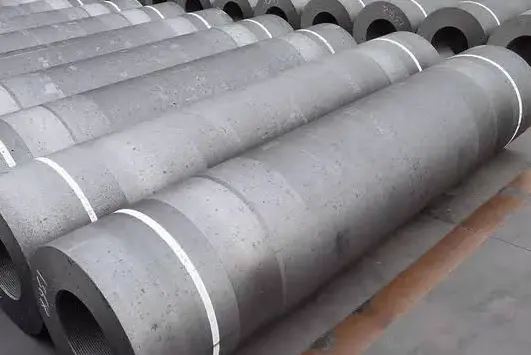
What Is a Graphite Electrode Made Of?
A graphite electrode is an engineered carbon product, not natural graphite. It's manufactured from:
- Petroleum coke and needle coke — the carbon-rich raw materials
- Coal tar pitch — used as a binder
- Small amounts of additives — to control porosity, density, and performance
The manufacturing process involves several stages: raw materials are mixed and kneaded, extruded or molded into round columns, baked at high temperature, impregnated with pitch to fill internal pores, and finally graphitized at temperatures above 2,500°C. In the graphitization furnace, the disordered carbon atoms rearrange into the crystalline, layer-like structure that gives the electrode its conductivity and heat resistance.
Depending on the grade, graphite electrodes are classified as:
- RP (Regular Power) — for smaller furnaces and lighter duty
- HP (High Power) — for medium-sized EAFs
- UHP (Ultra High Power) — for large, high-intensity steelmaking furnaces
The higher the grade, the lower the electrical resistance, the higher the allowable current density, and the better the performance under extreme conditions.
How Do Graphite Electrodes Conduct Electricity in an EAF?
In a typical electric arc furnace, three graphite electrodes are suspended from the furnace roof and connected to the three phases of the power supply. Current flows down through each electrode, jumps across the gap to the scrap steel as a powerful electric arc, and returns through the furnace bottom.
The arc temperature can exceed 3,000°C — hot enough to melt scrap steel in minutes. Because the electrode itself must carry the entire furnace current, its conductivity directly affects furnace efficiency, electricity consumption, and melting speed.
This is where electrode quality matters. A lower-resistance electrode wastes less energy as heat along its own length, delivers more power to the arc, and runs at a lower surface temperature — which means slower oxidation and a longer service life. For this reason, steelmakers specify UHP electrodes for high-power furnaces, where every kilowatt counts.
Key Electrical Properties of Graphite Electrodes
| Grade | Nominal Diameter | Allowable Current | Current Density | Typical Resistivity |
|---|---|---|---|---|
| UHP | 350 mm | 20,000–30,000 A | 20–30 A/cm² | ~4.8–5.8 µΩ·m |
| HP | 350 mm | 17,400–24,000 A | 17–24 A/cm² | ~6.0–7.0 µΩ·m |
| RP | 350 mm | Lower load | Lower density | ~8.0–8.5 µΩ·m |
Two takeaways stand out from this table. First, even a mid-size electrode like the 350 mm grade carries enormous current — far more than a typical household could ever use. Second, resistivity drops as you move from RP to UHP, which is exactly why ultra-high-power electrodes are specified for modern, high-efficiency furnaces.
What Is a 350 Graphite Electrode?
The 350 graphite electrode — 350 mm in nominal diameter, or 14 inches — is one of the most widely used sizes in the industry. It strikes a balance between current-carrying capacity and practical furnace geometry, making it a common choice for:
- Electric arc furnaces in medium-capacity steel plants
- Ladle furnaces (LF) for refining and alloying
- Submerged arc furnaces for ferroalloy production
In UHP grade, a 350 graphite electrode delivers 20,000–30,000 A with a current density of 20–30 A/cm², which is more than enough for the intense melting cycles of modern steelmaking. Its combination of high conductivity, mechanical strength, and thermal shock resistance makes it dependable through rapid heating and cooling cycles, day after day.
Why Not Use Copper or Steel Electrodes?
If graphite conducts electricity, why not simply use copper, which is a better conductor?
The answer is that an electrode in a steel furnace faces conditions no ordinary metal can survive:
- Extreme heat — Graphite sublimates (turns directly from solid to gas) only above roughly 3,600°C, so it holds its shape at arc temperatures where copper would melt instantly.
- Thermal shock — Graphite's low thermal expansion and high thermal conductivity let it absorb rapid temperature swings without cracking.
- Chemical stability — Graphite is essentially inert in contact with molten steel, so it won't contaminate the melt the way metal electrodes would.
- Strength at temperature — Unlike metals, graphite actually gains strength as temperature rises, up to around 2,400°C.
In short, graphite offers a unique combination no single metal can match: it's conductive enough to carry furnace current, yet tough enough to survive inside a furnace.
What Affects the Conductivity of a Graphite Electrode?
Not all graphite electrodes conduct equally. Several factors determine real-world performance:
- Grade — UHP electrodes are graphitized more thoroughly and have lower resistivity than RP or HP grades.
- Density and porosity — A denser electrode with fewer pores conducts better and oxidizes more slowly.
- Impurity level — Metallic impurities increase resistance and can contaminate the steel being melted.
- Joint quality — Electrodes are connected end-to-end with threaded nipples; a poor joint creates high-resistance hotspots that waste power and cause premature breakage.
For buyers, the practical takeaway is simple: specify the correct grade for your furnace, and source electrodes from a manufacturer with consistent quality control — because in high-current operation, small differences in resistivity translate directly into electricity costs and electrode consumption.
FAQ About Graphite Electrode Conductivity
Are graphite electrodes good conductors of electricity? Yes. Graphite's layered structure leaves one free electron per carbon atom, creating a mobile "electron sea" that conducts current almost like a metal. UHP electrodes carry up to 30,000 A in steelmaking furnaces.
Does a graphite electrode conduct electricity better than copper? No — copper has lower resistance per meter. But copper melts at furnace temperatures and reacts with molten steel, so graphite is the only practical electrode material for EAF steelmaking despite being less conductive than copper.
What is the current capacity of a 350 graphite electrode? A UHP 350 graphite electrode typically handles 20,000–30,000 A with a current density of 20–30 A/cm². HP grade electrodes carry approximately 17,400–24,000 A.
Why is graphite the only non-metal that conducts electricity? Because of its unique atomic structure: each carbon atom uses only three of its four valence electrons for bonding, leaving one delocalized electron free to move across the layers and carry current.
Does temperature affect graphite's conductivity? Yes. Graphite's resistivity varies with temperature, and it's designed to maintain stable performance across the extreme temperature swings inside an electric arc furnace.
Conclusion
So, do graphite electrodes conduct electricity? Absolutely — and this conductivity is the entire foundation of modern electric arc furnace steelmaking. Understanding why graphite conducts, how electrode grade affects performance, and what a 350 graphite electrode can deliver helps buyers choose the right product for their furnace and budget.
If you're sourcing graphite electrodes for an EAF, ladle furnace, or ferroalloy application and need advice on the right grade and diameter — including the 350 graphite electrode — our team is happy to help. Contact us for specifications, pricing, and a free quote.
Post time: 09-10-2026