
Graphite rods are used where electrical conductivity, heat resistance, machinability, thermal stability, or chemical compatibility is required. Common applications include electric arc furnaces, metal smelting, electrical discharge machining, high-temperature heating systems, laboratory equipment, electrochemical processes, and custom carbon components.
The correct graphite rod depends on its grade, density, grain size, electrical resistivity, strength, purity, and service environment. A rod for precision EDM machining is not the same as a large graphite electrode used in a steelmaking furnace. Likewise, an SHP Graphite Rod should be selected according to the actual furnace power, current load, diameter, connection design, and operating conditions.
Quick answer: common uses of graphite rods
| Application | Why graphite is used | Recommended product focus |
|---|---|---|
| Electric arc furnace steelmaking | Conducts high electrical current and withstands demanding furnace conditions | Graphite electrode grade matched to furnace power |
| Ladle furnace refining | Supports electric heating during steel refining | High-power or SHP-grade electrode selection |
| Ferroalloy and non-ferrous smelting | Delivers electrical energy into high-temperature processes | Electrode grade matched to current density |
| EDM machining | Machines complex conductive workpieces with good detail control | Fine-grain, high-purity EDM graphite |
| High-temperature furnaces | Provides thermal stability and conductivity in suitable atmospheres | Dense graphite rods or custom furnace components |
| Electrochemical equipment | Conductive and suitable for some chemical-process environments | Grade selected for electrolyte and corrosion conditions |
| Research and laboratory work | Used as electrodes, heating elements, and test components | High-purity or application-specific graphite |
| Custom machined parts | Easy to machine into specific shapes | Isostatic or extruded graphite stock |
Why graphite rods are useful
Graphite is valued in industrial applications because it combines several important material properties.
Electrical conductivity
Graphite can conduct electricity, making it useful for electrodes, current-carrying components, electrochemical cells, and electric heating applications.
In electric arc furnaces, graphite electrodes transfer electrical energy into the furnace charge. The resulting arc produces the intense heat required for steelmaking and other high-temperature metallurgical processes.
High-temperature performance
Graphite can perform in very high-temperature environments when the atmosphere and operating conditions are properly controlled. This makes graphite rods suitable for furnace components, thermal-process equipment, and metallurgical applications.
However, graphite can oxidize in the presence of oxygen at elevated temperatures. It should not be treated as universally oxidation-resistant. Furnace atmosphere, temperature, protective coatings, and operating time all affect service life.
Thermal conductivity and thermal-shock resistance
Graphite can transfer heat effectively and tolerate rapid temperature changes better than many conventional materials. These properties are useful in thermal systems, molds, crucibles, heaters, and furnace tooling.
Machinability
Graphite is easier to machine than many hard engineering materials. Manufacturers can produce rods, blocks, plates, electrodes, molds, fixtures, nozzles, and custom parts with detailed shapes.
This is especially important in EDM, semiconductor processing, glass manufacturing, continuous casting, and custom high-temperature equipment.
Low friction and self-lubricating behavior
Certain graphite grades are used in dry-running or low-lubrication applications because graphite has natural lubricating characteristics. This can be valuable in selected seals, bearings, sliding components, and mechanical carbon parts.
The final product must still be selected according to load, speed, temperature, counterface material, and chemical environment.
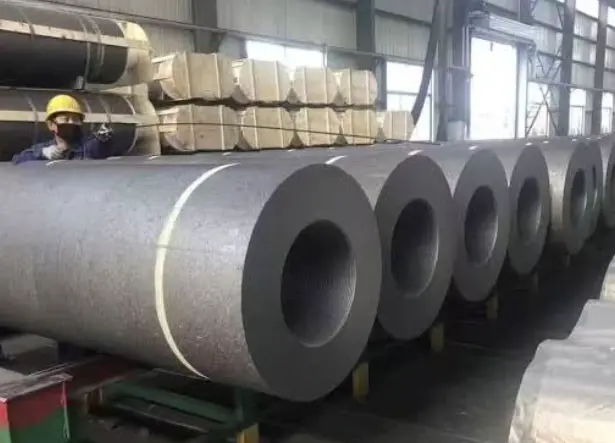
Graphite rods for electric arc furnaces
One of the most important uses of large graphite rods is as graphite electrodes in electric arc furnaces. These electrodes conduct high current into the furnace, creating an electric arc that melts scrap steel or supports other metallurgical processes.
Graphite electrodes may be classified by power grade, such as:
- Regular-power graphite electrodes
- High-power graphite electrodes
- Super-high-power graphite electrodes
- Ultra-high-power graphite electrodes
The exact commercial terminology and performance limits can vary by manufacturer. Buyers should not select a grade based only on the label “SHP.” Instead, they should compare the complete technical data sheet, including resistivity, bulk density, flexural strength, thermal-expansion characteristics, allowable current range, electrode diameter, and nipple specification.
What is an SHP Graphite Rod?
An SHP Graphite Rod generally refers to a super-high-power graphite electrode or graphite rod intended for higher-current metallurgical applications than standard or high-power grades.
SHP-grade products are often selected for electric arc furnaces, ladle furnaces, alloy production, and other processes where current load and thermal demand are greater than ordinary electrode conditions.
A suitable SHP graphite product should be evaluated according to:
- Furnace transformer capacity
- Secondary current
- Electrode diameter
- Electrode length
- Current density
- Furnace operating cycle
- Scrap mix or raw material
- Electrode-column alignment
- Joint and nipple design
- Cooling conditions
- Oxidation control
- Breakage and consumption history
A larger or higher-grade electrode is not automatically better. If the electrode diameter, current load, or nipple connection is mismatched to the furnace, the system may experience excessive consumption, joint failure, breakage, or unstable operation.
Graphite rods for EDM machining
Graphite is widely used as an electrode material for electrical discharge machining. EDM removes material from conductive workpieces through controlled electrical discharges between the tool electrode and the workpiece.
Graphite rods and blocks used for EDM are typically selected for:
- Fine grain structure
- Good machinability
- Stable electrical properties
- Low wear rate
- Surface-finish requirements
- Complex mold geometry
- Required electrode size
EDM graphite is normally different from electric-arc-furnace graphite electrodes. Fine-grain graphite can support detailed machining and precision mold work, while furnace electrodes are designed for large-scale current transfer and severe thermal operation.
Graphite rods for furnace and heating applications
Graphite rods can be used as heating elements, supports, fixtures, susceptors, and thermal-process components in suitable high-temperature systems.
Potential uses include:
- Vacuum furnaces
- Inert-gas furnaces
- Heat-treatment equipment
- Sintering systems
- Crystal-growth equipment
- Metallurgical furnaces
- Laboratory heating systems
The material grade must match the atmosphere. High-temperature graphite applications often require vacuum, inert, or controlled gas environments because exposure to oxygen at elevated temperatures can increase oxidation and reduce component life.
Graphite rods for electrochemical processes
Graphite rods can also be used as conductive electrodes in selected electrochemical processes. Their usefulness comes from electrical conductivity and compatibility with some operating media.
Possible applications include:
- Electrolysis equipment
- Electrochemical test cells
- Water-treatment systems
- Metal recovery processes
- Laboratory electrodes
- Cathodic and anodic process equipment
Chemical compatibility should always be reviewed carefully. Graphite performance depends on the electrolyte, temperature, current density, impurities, pressure, and whether the material has been impregnated or specially treated.
Graphite rods for custom machined components
Graphite rods can be machined into application-specific parts, such as:
- Furnace fixtures
- Molds
- Nozzles
- Bushings
- Seals
- Heating elements
- Conductive contacts
- Carbon brushes
- Casting components
- High-temperature supports
For custom parts, the raw graphite grade matters as much as the finished dimensions. A component requiring high purity may need a different material from a component requiring high strength, low porosity, or improved thermal-shock resistance.
How to choose the right graphite rod
Before purchasing graphite rods, define the actual operating requirement.
| Selection factor | Why it matters |
|---|---|
| Application | Determines whether the rod is for furnace, EDM, electrochemical, or mechanical use |
| Electrical resistivity | Affects current-carrying performance |
| Bulk density | Influences strength, porosity, and material consistency |
| Grain size | Important for surface finish, machining precision, and performance |
| Flexural strength | Relevant for handling, mechanical loading, and breakage resistance |
| Purity or ash content | Important for electronics, laboratory, and specialty applications |
| Diameter and length | Must match equipment design and installation space |
| Thread and nipple specification | Critical for large graphite electrode columns |
| Operating atmosphere | Determines oxidation risk and suitable grade |
| Temperature and thermal cycling | Affects material stability and service life |
| Chemical exposure | Determines whether standard or impregnated graphite is required |
For furnace electrodes, use the actual operating current and equipment design to select the grade. For machined graphite parts, start with the required physical and chemical performance before defining the final dimensions.
Common mistakes when selecting graphite rods
Choosing by diameter only
A graphite rod with the correct diameter can still be unsuitable if its density, resistivity, grain structure, strength, or connection system does not match the application.
Confusing a graphite rod with a graphite electrode
A graphite rod may be machining stock, a laboratory electrode, a heating component, or a custom carbon part. A graphite electrode for an electric arc furnace is a specialized product designed for high-current operation and often includes a compatible threaded nipple system.
Ignoring the operating atmosphere
Graphite can perform very well at high temperatures in controlled environments, but oxygen exposure can cause oxidation. Furnace atmosphere must be included in material selection.
Using an SHP grade without verifying furnace data
SHP graphite products should be selected through current, transformer, electrode diameter, joint design, and operating-condition data. A grade name alone is not enough for reliable furnace performance.
Conclusion
Graphite rods are useful for electrical, thermal, mechanical, and high-temperature applications. They are commonly used in electric arc furnaces, ladle furnaces, EDM machining, electrochemical systems, laboratory equipment, and custom industrial components.
The best graphite rod is the one matched to the real application. For furnace use, verify current load, electrode size, furnace power, nipple connection, and consumption target. For machining or specialty components, focus on grain size, density, purity, strength, and chemical environment.
For graphite rod specifications, SHP graphite electrode enquiries, samples, or project support, contact ZGTDTS.
FAQ
What are graphite rods mainly used for?
Graphite rods are used for electric arc furnace electrodes, EDM machining, high-temperature heating systems, electrochemical processes, laboratory equipment, and custom carbon components.
Can graphite rods be used at high temperatures?
Yes, graphite can perform in high-temperature applications when the operating atmosphere is suitable. In oxygen-containing environments, graphite can oxidize at elevated temperatures, so atmosphere control is important.
What is an SHP Graphite Rod used for?
An SHP Graphite Rod is generally used for higher-power metallurgical applications, such as electric arc furnaces and ladle furnaces. It should be matched to the furnace current, electrode diameter, transformer capacity, and connection specification.
What should I check before buying graphite rods?
Check the intended application, dimensions, density, electrical resistivity, grain size, strength, purity, operating temperature, atmosphere, and any connection or machining requirements.
Post time: 09-30-2026