
If you’re searching for graphite carbon felt for a furnace, you’ve probably noticed that product listings are confusing. Titles say “graphite,” “carbon,” or “insulation,” but the material inside may be built for something else entirely. The short answer: start with your furnace’s atmosphere and peak temperature, choose a felt family that fits those conditions, and confirm the choice on the datasheet rather than the product name. Competitor listings suggest rough starting points, such as carbon felt for oxidizing air at moderate temperatures and PAN-based graphite felt for vacuum or inert-gas service above about 800°C, but treat those as hypotheses to verify. This guide walks through the prerequisites, a furnace-to-felt decision matrix, how to tell the material families apart, a spec-first checklist for rejecting mismatched listings, and how to choose precursor and thickness for your application.
Prerequisites: What You Need Before Specifying Felt
Short answer: Specify felt from your furnace atmosphere and peak temperature, not from the product name. Carbon versus graphite comes second.
Carbon felt is carbonized at lower temperatures and keeps more ash. Graphite felt gets a higher-temperature treatment, which gives higher carbon content and lower ash. Ash matters in vacuum and inert service because it can outgas or contaminate the hot zone.
Decision matrix (starting hypotheses)
| Atmosphere | Temperature band* | Felt family | Typical setup |
|---|---|---|---|
| Oxidizing air | Up to ~400°C | Carbon felt | Air-exposed zone |
| Vacuum or inert gas | Up to ~800°C | Carbon felt | Sealed cylindrical hot zone |
| Vacuum or inert gas | Up to 2200°C | PAN graphite felt | Sealed hot zone, induction or cylindrical |
*Temperature limits come from competitor listings. Confirm each one against the manufacturer’s datasheet before you buy.
Leaks change the answer. A furnace running at 700°C suits carbon felt under vacuum. If air leaks in, that same felt exceeds its ~400°C oxidizing limit. Treat leak rate as part of the spec.
Steps before you request quotes
- Sketch the hot zone. Record diameter, length, wall clearance, maximum and typical temperature, and atmosphere (air, vacuum level, or gas type). Why: These numbers set felt area and family. How: Use CAD or a dimensioned hand sketch in millimeters.
- Build a spreadsheet. Calculate wall and end-cap area, then log sample and bulk prices per m² in separate columns. Why: Sample prices are not comparable to bulk unit prices.
- Collect documents. Get datasheets for at least two candidate felts, plus ash, carbon-content, and outgassing certificates where available.
- Budget for two to three sample orders before any bulk commitment.
- Plan time. Allow 2 to 4 hours for internal specification and 1 to 2 weeks for sample lead time and testing.
Common mistakes
Forum threads often ask whether “graphite” and “carbon” mean different things. They do, and the difference affects ash and purity. Also, some listings file activated carbon felt under “Graphite Insulation.” That product is built for gas adsorption, not thermal insulation. Check the intended use on the datasheet before you compare prices.
If the felt will act as an electrode in a flow battery or fuel cell, this matrix does not cover that selection. Send your sketch and atmosphere data to our team for a fit check, or browse graphite carbon felt options once your numbers are set.
Step 1: Map Your Furnace Atmosphere and Temperature to a Felt Family
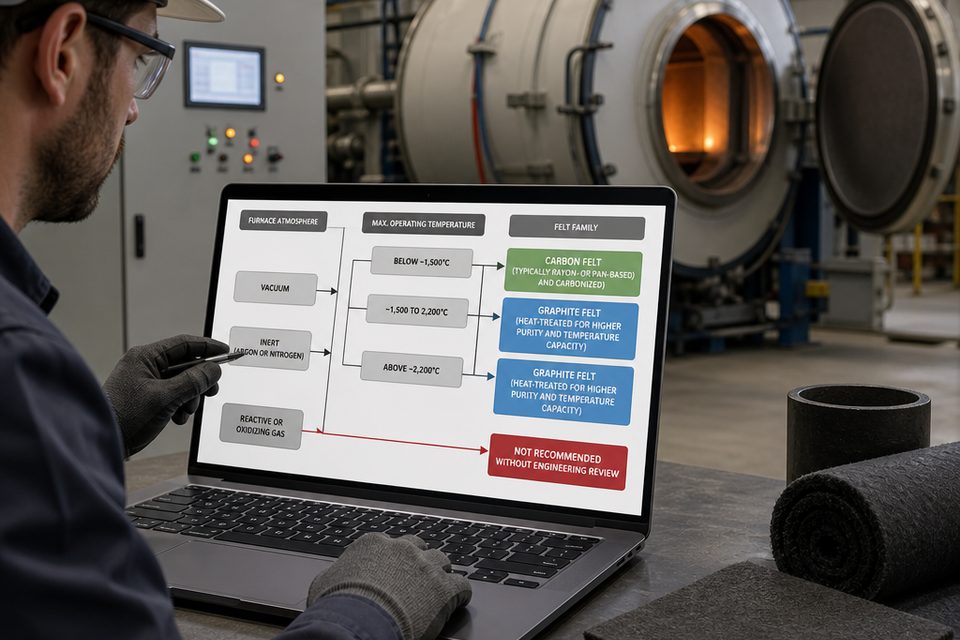
Start with the atmosphere, then the peak temperature, and the felt family follows. Oxidizing conditions rule out carbon and graphite felt unless an engineering review confirms otherwise. Verify final ratings against the supplier’s datasheet before ordering.
Sort your furnace into one of three atmosphere bands: oxidizing air, vacuum, or inert gas. Then record its peak temperature. Do this before you look at any felt listing. Atmosphere often limits felt life more than temperature does.
What to record (30 minutes)
- Atmosphere band: oxidizing air, vacuum, or inert gas such as argon or nitrogen.
- Peak temperature: the highest temperature the hot zone reaches, not the setpoint you run most often.
- Furnace type: induction (coil-coupled) or cylindrical radiant hot zone.
Why atmosphere comes first
Competitor listings commonly cite about 400°C for carbon felt in oxidizing air and about 800°C for carbon felt in vacuum or inert gas. PAN-based graphite felt is listed up to about 2200°C. Treat these numbers as starting hypotheses, not purchase specs. Test conditions vary, and air leaks can push a vacuum furnace into an oxidizing band during a hot cycle. The 800°C figure no longer applies once the felt sees air at temperature.
How to build the matrix
Use four columns: atmosphere, peak temperature, furnace type, and candidate felt family.
| Atmosphere | Peak temperature | Candidate felt family |
|---|---|---|
| Oxidizing air | Up to about 400°C | Carbon felt (starting hypothesis) |
| Vacuum or inert | Up to about 800°C | Carbon felt (starting hypothesis) |
| Vacuum or inert | Up to about 2200°C | PAN graphite felt (starting hypothesis) |
| Oxidizing air | Above 400°C | No listed range fits; ask the supplier before buying |
For induction furnaces, check whether the felt sits inside the coil field. Carbon felt conducts electricity, so it can couple to the coil and heat unintentionally.
Don’t filter by name
Product titles are the least reliable spec on a listing. A “Graphite Insulation” title can sit over an activated carbon felt made for gas-flow adsorption. Buyers who filter by name can order the wrong material without noticing.
Check these five fields on the datasheet:
- Precursor: PAN or rayon.
- Carbon content: one competitor guide puts carbon felt near 90% carbon. Check the figure on your datasheet.
- Ash ppm: high ash can contaminate a clean furnace load.
- Max service temperature: must sit above your peak temperature.
- Atmosphere rating: must name oxidizing, vacuum, or inert use.
Reject any listing where the title and datasheet disagree. Also reject any listing that omits the atmosphere rating. Ask the supplier for the missing field in writing.
Carbon vs. graphite in plain terms
Carbon felt is processed at lower temperatures and keeps more ash and disorder. Graphite felt goes through a higher-temperature step that produces a more ordered structure. Activated carbon felt is a separate product. Its process creates surface area for adsorption, so it does not serve as a furnace insulation material.
PAN or rayon?
PAN fibers are coarser and have lower surface area than rayon, according to CeraMaterials. For furnace insulation, the temperature band usually decides the choice before precursor does. Surface area matters more for flow battery electrodes. Ask the supplier which precursor they use and why.
If your matrix points to graphite felt, review the graphite electrode product range. For help checking a datasheet against your furnace data, contact our team.
Step 2: Separate Carbon Felt, Graphite Felt, Activated Carbon Felt, and Carbon Fiber
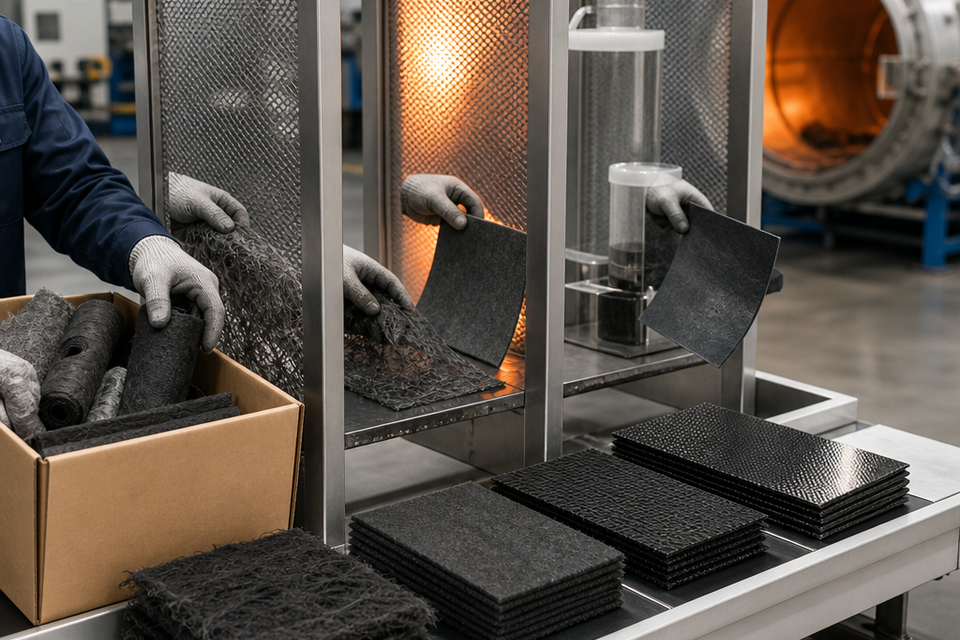
Use the three gates in order. Form factor separates carbon fiber from felts. Heat-treatment temperature separates carbon felt from graphite felt. Activation separates activated carbon felt from the non-activated grades. Confirm each gate against the supplier’s spec sheet before ordering.
Check the datasheet, not the product title, to confirm which family a felt belongs to. Carbon felt, graphite felt, activated carbon felt, and carbon fiber differ in processing and intended use, and a “graphite” label does not guarantee graphite.
What to do: Compare each candidate on the datasheet fields: maximum temperature, atmosphere, carbon content, ash level, precursor, and intended use. Then match the furnace requirement to the family.
Why it matters: Graphite felt is generally heat-treated to a higher degree of graphitic order than carbon felt. Carbon felt is generally about 90% carbon. Activated carbon felt is gas-flow activated for surface area and adsorption, not thermal insulation. One activated carbon felt listing sits under “Graphite Insulation” in its title, which is exactly how buyers end up with the wrong material.
| Family | Key characteristic | Typical use | Datasheet fields to check |
|---|---|---|---|
| Carbon felt | Carbon fiber, about 90% carbon | Furnace insulation at moderate temperatures | Max temp, atmosphere |
| Graphite felt | Higher graphitic order; PAN-based rated to 2200°C | High-temperature furnace insulation, electrode backing | Max temp, precursor, purity |
| Activated carbon felt | Gas-flow activated, high pore structure | Adsorption, specialized applications | Surface area, pore structure |
| Carbon fiber | Fiber form, not a felt mat | Structural and composite uses | Confirm product form first |
How to do it:
- Write down the furnace’s maximum temperature and atmosphere (oxidizing, vacuum, or inert).
- If the furnace runs oxidizing above about 400°C, carbon felt is out. Carbon felt is commonly rated near 400°C oxidizing and 800°C in vacuum or inert gas.
- If the furnace needs more than about 800°C, move to graphite felt. PAN-based graphite felt is rated to 2200°C.
- Reject any candidate whose datasheet does not state a temperature rating. Ask the supplier for it.
Precursor matters for graphite felt. CeraMaterials notes that PAN-based felt has coarser fibers and lower surface area than rayon-based felt. Surface area matters most for flow battery electrodes, where Fuel Cell Store sells PAN-based felts. For insulation, the coarser structure is usually less important than temperature rating. Treat that as a general decision criterion, not a verified performance claim for a specific product.
Common mistakes:
- Trusting the product title over the datasheet.
- Assuming any “graphite” product handles any furnace temperature.
- Ignoring atmosphere. Oxidizing conditions lower the usable temperature for carbon felt.
Evidence-gathering plan (about 1-2 hours per candidate, estimate):
- Ask suppliers for their ash and carbon-content test methods. Compare methods, not just numbers.
- For vacuum or crystal growth processes, request outgassing data before approving a material.
- Normalize prices per usable area. The activated carbon felt sample sheet (about 2 mm x 8″ x 12″, roughly 0.062 m²) lists at $22-$32. That works out to roughly $355-$517 per m² at the sample tier.
Open items: Ash content values, carbon content for each graphite candidate, outgassing data, and bulk pricing. These figures are not in the sources reviewed, so request them before you compare suppliers. Start with a graphite felt product review or send your furnace specs to our team for a datasheet check.
Step 3: Apply a Spec-First Checklist and Reject Mismatched Listings
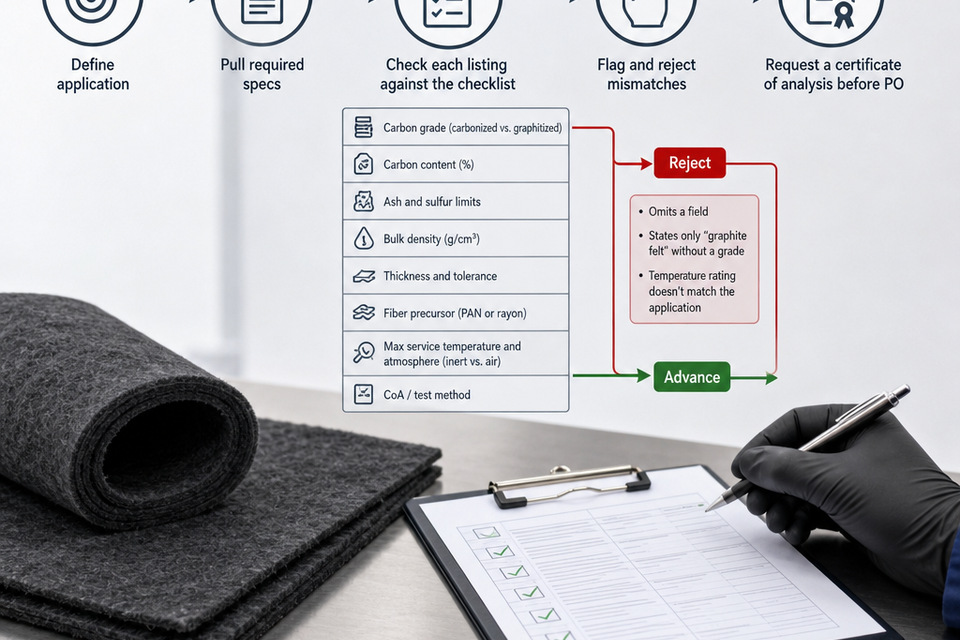
Before comparing prices, confirm that every listing states the carbon grade, carbon content, density, thickness tolerance, and rated temperature for your atmosphere. Listings missing these fields cannot be verified and should be rejected, regardless of price.
Score every candidate on five datasheet fields before you compare prices, and reject any listing whose title and datasheet disagree. Product names are the least reliable spec on a listing. Community threads keep asking whether “graphite” and “carbon” felt are different, and one common listing sells activated carbon felt under a “Graphite Insulation” title. A buyer who filters by name can order adsorption-grade felt for a furnace, or insulation-grade felt for a filter.
The Five-Field Checklist
- Precursor (PAN or rayon): Sets fiber structure, surface area, and purity.
- Carbon content: The carbon percentage of the finished felt.
- Ash (ppm): Residual mineral content. Higher ash raises contamination risk in sensitive processes.
- Maximum service temperature: Separate values for oxidizing air and for vacuum or inert gas.
- Atmosphere rating: The atmospheres the supplier has rated the felt for.
For temperature, carbon felt is commonly listed around 400°C in oxidizing conditions and around 800°C in vacuum or inert gas. PAN-based graphite felt is listed up to 2200°C. Match these figures to your furnace atmosphere, not to the highest number on the page.
How to Fill It In
- Copy each value from the datasheet, not from the listing title or summary.
- Mark any blank field. Request it from the supplier before comparing prices. A quote without a complete datasheet cannot be compared fairly.
- For carbon content and ash, ask which test method produced the number and whether it applies to the lot you will receive.
- Reject the listing if the title says one material and the datasheet says another.
For one listing with a complete datasheet, this takes about 15 minutes. Each missing field can add days of supplier back-and-forth.
Illustrative Scenario (Hypothetical)
Assume a flow battery developer compares 2.5 mm, 4.6 mm, and 6.3 mm electrode felts for one stack with a fixed compartment gap. These numbers are hypothetical, not measured.
- 2.5 mm: Holds a compression target with little movement. Electrolyte flows with low resistance, but the felt offers less surface area.
- 4.6 mm: A middle option. It needs more compression travel, which raises contact stress on the membrane.
- 6.3 mm: Adds reactive surface, but must compress further to fit the gap. Higher flow resistance and creep under compression can shorten cycle life.
The precursor changes the result. CeraMaterials notes that PAN has coarser fibers and lower surface area than rayon. In this model, a PAN 6.3 mm felt may lose surface area the developer needs. The developer might test rayon at 4.6 mm to recover surface area without adding thickness. Run your own tests before you commit.
Substitute your own cell parameters: gap, target compression, electrolyte flow rate, and cycle-count goal. Then fill the same checklist for each candidate.
Common Mistakes
- Filtering by name instead of reading the datasheet.
- Comparing prices before the spec sheet is complete.
- Accepting a carbon-content or ash number with no test method.
For help filling in the checklist for a specific felt, contact our team or review our graphite carbon felt options.
Step 4: Choose PAN or Rayon Precursor for Your Graphite Felt
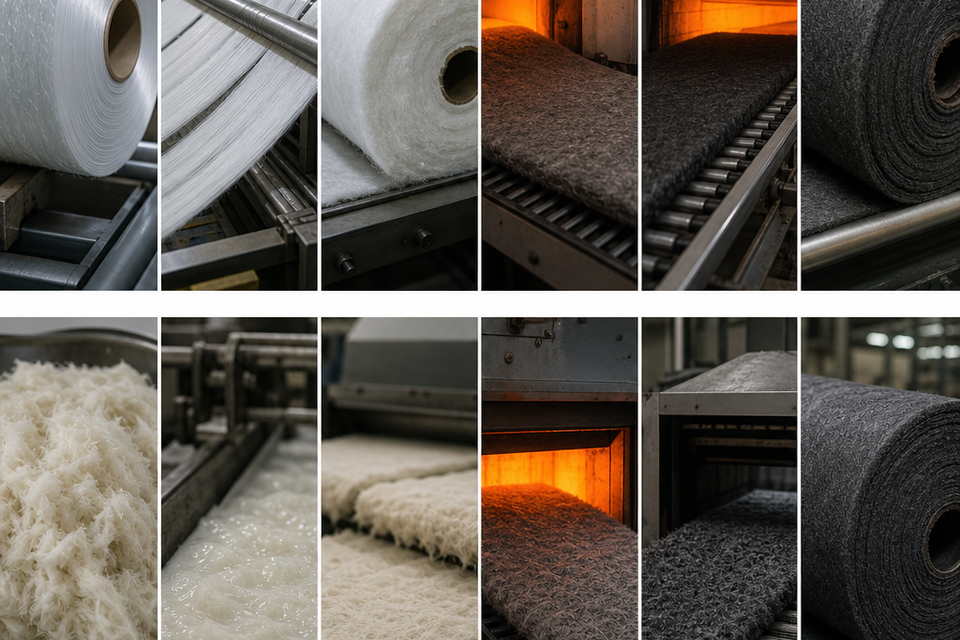
PAN and rayon follow the same thermal path to graphite felt but differ in carbon yield, processing sensitivity, and cost. Match the precursor to your application’s temperature, purity, and budget requirements before you specify.
Choose rayon for electrochemical work where surface area matters most. Choose PAN for high-temperature insulation where cost and thermal stability lead. Most decisions come down to which factor your application cannot compromise on.
CeraMaterials notes that PAN felt has coarser fibers and lower surface area than rayon felt. Finer fibers and more surface area give an electrode more sites for reactions. Furnace insulation gets little benefit from that, so the extra cost rarely pays off.
Step 1: Rank the four factors (about 30 minutes)
- What: Rank fiber diameter, surface area, purity, and cost from 1 (least important) to 4 (most important).
- Why: Your top two factors decide the precursor. Trying to optimize all four usually leads to a compromise that meets none of them well.
- How: Write your ranking next to your operating conditions. Electrodes usually put surface area first. Insulation usually puts cost and thermal stability first.
Step 2: Check the candidate against your top two (about 1 hour)
- What: Pull the datasheet for each candidate and confirm the fiber and surface-area values for your exact product.
- Why: Product names do not tell you the precursor. Fuel Cell Store sells both PAN and rayon felts, so confirm the precursor on each listing.
- How: Match the precursor to your ranking using this table.
| Factor | PAN-based felt | Rayon-based felt |
|---|---|---|
| Fiber diameter | Coarser | Finer |
| Surface area | Lower | Higher |
| Best fit | Insulation, cost-sensitive furnace work | Electrodes where reaction sites matter |
Step 3: Test the choice in your cell stack (hypothetical example)
The following example is hypothetical. Replace the numbers with your own cell parameters.
Assume a developer needs a 2.0 mm compressed gap in a stack. The developer compares three felt thicknesses:
- 2.5 mm: needs about 20% compression to reach 2.0 mm.
- 4.6 mm: needs about 57% compression.
- 6.3 mm: needs about 68% compression.
Heavier compression reduces pore volume, which raises electrolyte flow resistance. It can also thin the felt faster over repeated cycles. In this scenario, the 2.5 mm felt keeps flow resistance low, but the developer must check whether it still gives enough active area.
Now the precursor changes the answer. A rayon 2.5 mm felt may offer more surface area per millimeter than a PAN felt of the same thickness. That could let the developer keep the light compression. A PAN felt might need the thicker 4.6 mm option to match surface area, which pushes compression up and flow resistance with it.
Common mistakes to avoid
- Choosing by thickness alone without calculating compression.
- Picking rayon for insulation because it sounds premium, without checking cost.
- Assuming “graphite felt” tells you the precursor. Always confirm it.
Pro tip: Ask your supplier for compressed-thickness data at your operating pressure. Uncompressed thickness alone will mislead your flow calculations. You can compare graphite carbon felt options or contact our team for samples before you commit to a stack design.
Step 5: Select Thickness and Compression for Flow Battery Electrode Felts
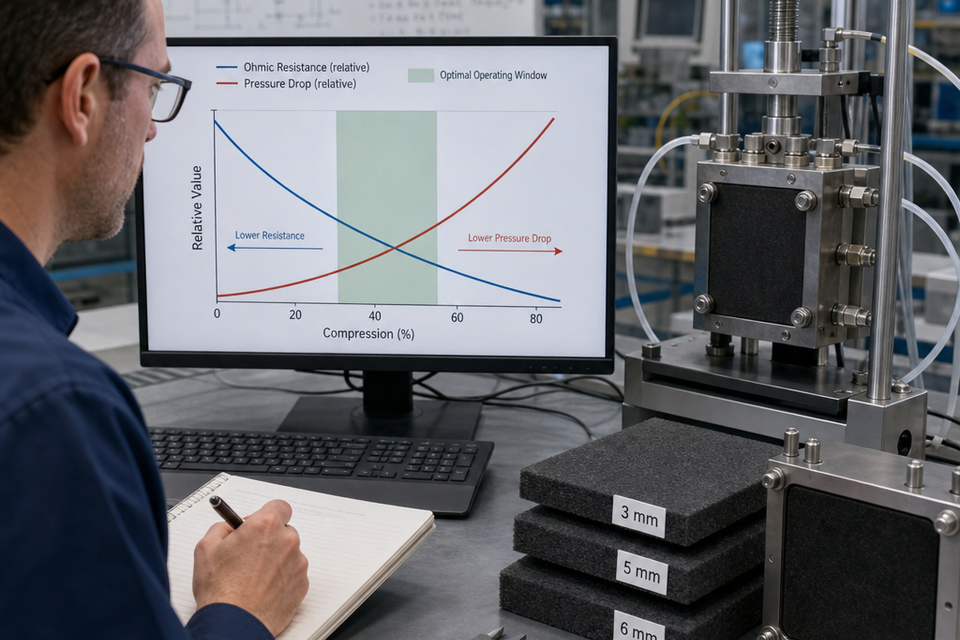
Thickness and compression trade off against each other. Greater compression lowers ohmic resistance by improving fiber-to-fiber and felt-to-plate contact, but it also reduces porosity and raises pressure drop across the electrolyte flow path. Work through the loop until both values fall within your stack’s operating window, and confirm the final spec with the felt supplier’s test data.
Choose the felt thickness that lands your compressed gap inside your target compression window. Work backward from the cell hardware, not forward from the catalog. Thickness only works after compression.
Thickness sets compression. Too little compression leaves gaps between the felt and the plates, which raises contact resistance. Too much packs the fibers tightly, which raises pressure drop and can make electrolyte flow uneven across the active area. Plan on about one hour for the calculations and a short fit check. Confirming the choice in cell testing takes weeks.
Step 1: Measure the compressed cell gap
- What: The space between plates when the stack is assembled and closed.
- Why: Felt
Conclusion
Specifying graphite carbon felt comes down to a few habits: classify your furnace by atmosphere and temperature first, read the datasheet fields instead of the title, and treat every rating as something to confirm. Use the checklist to score each candidate on precursor, carbon content, ash, service temperature, and atmosphere rating. If a field is missing or a claim has no test method behind it, mark it as unverified and ask the supplier before you compare prices. For electrode or flow-related work, the precursor and thickness decisions matter just as much. Your practical next step is to fill in the checklist for your two strongest candidates and send the gaps to a supplier. If you want help matching a felt to your furnace or cell design, reach out to our team with your temperature, atmosphere, and dimensions, and we can help you narrow the shortlist.
Post time: 11-19-2026