
The term causes real confusion in purchasing, because “rough” sits next to two unrelated ideas: the surface finish of a finished electrode, and the grade of the graphite itself. This guide separates them, then covers how a rough electrode is specified, inspected, handled and costed against a finished one.
Where “rough” sits in the production flow
A graphite electrode is not a single-step product. Understanding the sequence makes the meaning of “rough” obvious, because it names a precise stopping point in the line.
- Raw materials. Needle coke or petroleum coke is crushed, sieved and mixed with coal tar pitch binder. Grade — RP, HP or UHP — is largely decided here, through coke quality and the needle-coke fraction.
- Forming. The paste is extruded or moulded into a green electrode of oversized dimensions.
- Baking. Slow firing at roughly 800–1200 °C carbonises the binder and builds mechanical strength.
- Impregnation and re-baking. For HP and UHP grades, the baked body is vacuum/pressure impregnated with pitch and re-baked to raise density and lower resistivity.
- Graphitization. The body is fired to about 2500–3000 °C in an Acheson or lengthwise graphitization furnace, converting the carbon into graphite.
- Rough machining. The graphitized body is peeled or rough-turned to close-to-final diameter and cut to close-to-final length, with allowance left for finishing.
- Finish machining. Taper threads and sockets are cut, end faces are faced square, chamfers are formed and the joint is gauged.
A rough electrode leaves the line between steps 6 and 7. Everything that makes the electrode conductive and strong has already happened; only the geometry that makes it joinable and dimensionally exact is missing.
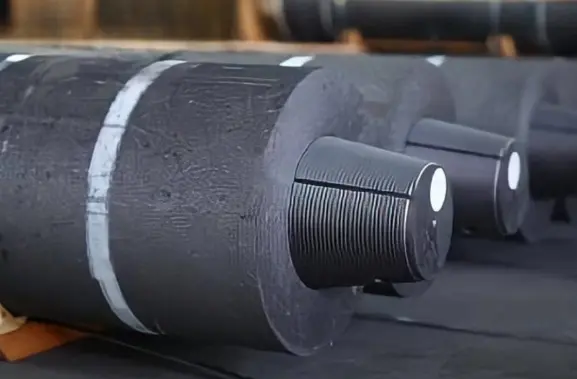
Rough vs finished: the practical differences
| Item | Rough graphite electrode | Finished graphite electrode |
|---|---|---|
| Machining state | Rough-turned body, allowance left | Fully machined, ready to assemble |
| Diameter | Finished diameter plus roughly 5–15 mm allowance | Finished diameter within the agreed tolerance |
| Length | Cut with end allowance | Finished length, square-faced ends |
| Threads and sockets | None | Taper threads and sockets cut and gauged |
| End faces | Sawn or rough, not square to precision | Faced, square and chamfered |
| Joint performance | Buyer's responsibility after machining | Supplier's responsibility, tested as a joint |
| Price | Lower — no finishing cost | Higher — includes machining and gauging |
| Lead time | Usually shorter, no finishing queue | Longer, finishing capacity dependent |
| Best for | Buyers with machining capability, custom joints, non-jointed uses, stock | Furnace operators who assemble straight from the crate |
Allowance figures are indicative. The exact value must be agreed per order, because it depends on electrode size, the buyer's machining setup and how much material each pass removes.
Grades and sizes that are sold rough
All three regular grades can be supplied rough, but the commercial logic differs by grade.
- RP (regular power) — used in lower-power furnaces and non-steel applications. Rough RP stock is common where buyers machine their own joints.
- HP (high power) — the mainstream steelmaking grade, denser and lower in resistivity than RP.
- UHP (ultra-high power) — needle-coke based, highest density and lowest resistivity, used in high-load electric arc furnaces. Rough UHP bodies are usually ordered by customers who have their own finishing lines or who specify a non-standard joint.
Typical nominal diameters run from about 75 mm up to 800 mm, with 300–700 mm dominating UHP steelmaking. Standard lengths cluster around 1800 mm, 2000 mm and 2200 mm, with custom lengths available on request. Always quote in millimetres, and state whether the figure is the finished diameter or the rough diameter — a 400 mm rough body is not a 400 mm finished electrode.
Our graphite electrode and carbon product range covers RP, HP and UHP grades in both rough and finished condition, with machining to drawing where required.
Why buyers choose rough graphite electrodes
Rough graphite electrodes are bought for five practical reasons, and each one maps to a different part of the buyer’s operation.
1. Lower piece cost
Finishing is labour, machine time and gauge time. Removing it from the supplier's scope removes it from the price. For a buyer who already runs a machining cell, that is a straightforward saving per tonne of electrode consumed.
2. Shorter lead time and simpler logistics
Rough bodies do not queue behind finishing schedules, and they are less fragile in transit because there are no thread roots to chip. They also stack and pack more densely in some configurations.
3. Freedom to specify a custom joint
Some furnace operators use a non-standard taper, a proprietary nipple profile, or a joint designed for a specific electrode column. Supplying rough lets them cut the joint to their own drawing instead of adapting to a catalogue standard.
4. Inventory flexibility
A rough body can be finished to different lengths or joint types later, so one stock item serves several end uses. That reduces the number of finished SKUs a distributor or a large plant has to hold.
5. Use where no joint is needed
Certain non-steel applications — some submerged-arc furnace duties, graphite stock for machining, and structural or conductive components — do not require a threaded joint at all. In those cases finishing would be wasted cost.
How to specify a rough graphite electrode
A purchase order that says only “rough graphite electrode, 400 mm” will produce a dispute. The specification needs to pin down the machining state and the physical properties separately.
| Parameter | What to state |
|---|---|
| Grade | RP, HP or UHP, with the property table that applies |
| Finished size | Finished diameter and finished length, in millimetres |
| Rough size | Rough diameter and rough length actually supplied, plus the allowance |
| Bulk density | Minimum g/cm³, measured per ASTM C651 or the agreed method |
| Resistivity | Maximum μΩ·m, measured per ASTM C611 |
| Mechanical | Flexural strength, Young's modulus and ash content limits |
| Thermal | Coefficient of thermal expansion, where the application is thermal-shock sensitive |
| End condition | Sawn or rough-turned, and whether end faces must be parallel |
| Nipples | Supplied separately or not; if supplied, grade, taper and quantity |
| Inspection | Certificate of analysis, dimensional report, and any third-party inspection |
| Packing | Wooden crate, end protection, moisture protection, marking |
Inspection and acceptance
Because the buyer takes over the finishing, rough graphite electrodes deserve a disciplined incoming check. A practical routine:
- Dimensions — diameter at several points along the body and at both ends, plus overall length, checked against the rough dimensions ordered.
- Visual — transverse and longitudinal cracks, chipped ends, deep turning marks, contamination and oxidation discoloration.
- Density and resistivity — sampled per batch rather than per piece, using the methods named in the order.
- Straightness — run-out matters more than usual, because a bent body will not clean up to a true finished diameter within the allowance.
- Documentation — certificate of analysis traceable to the batch, and a dimensional record for the pieces supplied.
Ultrasonic or eddy-current testing is available from many producers for critical columns; if internal cracks would ruin a large finished electrode, ask for it before the body is machined, not after.
Handling and storage
Graphite is brittle, and a rough body has no thread roots but does have thin, unsupported ends. Practical rules for rough graphite electrodes:
- Lift with slings or clamps around the body, never by the ends, and never drop the electrode onto a hard surface.
- Stack on timber bearers, not directly on concrete or steel, and keep the stack from rolling.
- Keep dry. Graphite absorbs moisture in open storage; a damp electrode introduced into a hot furnace is a thermal-shock risk and should be dried and preheated on a controlled curve.
- Protect the ends with caps or padding during transport, because end damage is the most common cause of a body that will not clean up.
- Graphite oxidises in air at elevated temperature — roughly above 450 °C — so stored stock should be kept away from furnace heat and hot flue gas.
Is rough actually cheaper?
Compare total cost, not invoice price. A rough graphite electrode plus your machining time, tooling, thread gauges, scrap allowance and inspection can exceed the price of a finished electrode — especially at small volumes, or when the joint quality matters more than the material cost.
Rough wins when you already have the machining capability, when volumes are large enough to amortise setup, when you need a custom joint, or when the electrode will not be jointed at all. Finished wins when the electrode goes straight into an electrode column and every joint has to hold under full current.
Three misunderstandings worth correcting
- “Rough means a lower grade.” No. A rough UHP body is still UHP graphite. Machining state and material grade are independent variables.
- “Rough means damaged or second-class.” No. Rough is a planned production stage, not a reject category. Seconds and offcuts are a different product.
- “Rough refers to surface roughness.” Sometimes buyers use the word loosely for surface finish, quoting an Ra value. Clarify which meaning applies: machining state, or surface roughness. Both can be specified, but they are not the same requirement.
Frequently asked questions
- What does “rough” mean in a rough graphite electrode?
- It describes the machining state. The body is graphitized and rough-machined with allowance on diameter and length, but the threads, sockets and precision end faces are not yet cut.
- Can a rough electrode go straight into a furnace?
- Not as a jointed column — it has no finished thread. It must be machined first. For clamped or non-jointed uses, confirm with the supplier that the ends and dimensions suit the holder.
- Is a rough electrode cheaper?
- Usually, because finishing is excluded. Whether it is cheaper overall depends on your machining cost, scrap rate and volume.
- What allowance should I ask for?
- Commonly 5–15 mm on diameter and a few millimetres on length, but it should be calculated from your own machining passes and stated explicitly in the order.
- Are nipples included?
- Normally not. Nipples are quoted and packed separately, in the grade and taper that match the electrode size.
Post time: 11-05-2026