
Choosing a graphite rod by catalog grade alone is a common way to end up with the wrong part. Buyers often see purity numbers, density, and grain size listed without context, then struggle to tell which spec actually matters for their process. The short answer: start with the service environment (air exposure or inert gas, temperature profile, and failure mode), then match oxidation limits, conductivity, purity, and machinability to that environment. Higher purity is not automatically the right choice, and the cheapest option is not always the safest.
This guide walks through that selection order, from gathering your process data to building a verifiable quote comparison. You’ll see how to compare grades on test-based numbers, when 99.95% purity can be a rational choice versus 99.997%, which dimensional and machining details to confirm before requesting a design-fit quote, and how to control handling and storage failures. Thresholds here are starting points to validate against your own specifications and supplier data sheets.
Prerequisites: Tools, Budget, and Information You Need Before Selecting a Graphite Rod
Before you compare graphite rods, gather four inputs: your process envelope, your application type, your reference standards, and a basic RFQ. Plan for one to two weeks of data gathering, three to five supplier responses, and 4-6 hours of internal engineering review.
Step 1: Define the process envelope. Record maximum and continuous operating temperature, atmosphere (air, nitrogen, argon, vacuum, or reducing gas), cycle frequency, and required service life. Oxidation behavior changes with atmosphere, so an air-exposed fixture and a nitrogen-protected furnace part rarely need the same grade.
Step 2: Name the application. Choose one: furnace element or fixture, electrochemical electrode, machined component, or reactor internal. Each sets different impurity and dimensional tolerances.
Step 3: Match purity to process sensitivity. Many buyers default to 99.997%. That choice often wastes budget. Trace impurities and ash matter most where they can enter the process or shift electrical behavior. Where they cannot, 99.95% is the rational choice.
| Process sensitivity | Impurity concern | Likely grade direction |
|---|---|---|
| Low: fixtures in air or inert gas | Ash has little effect on the process | 99.95% often suffices |
| Medium: machined parts with conductivity needs | Ash and resistivity affect fit and performance | Test both grades against your spec |
| High: electrodes where trace metals enter the reaction | Contaminants alter electrochemical output | Higher purity may be justified |
This table shows direction, not limits. Check every threshold against your process specification and the supplier’s data sheet. This brief includes neither.
Step 4: Collect reference standards. Pull ASTM C611 (electrical resistivity) and ASTM C561 (ash content). Confirm current edition numbers with your quality team before citing them internally. Ask each supplier to report both values for the same lot.
Step 5: Build the RFQ. List diameter, length, grade, purity, density, grain size, machining, quantity, packaging, and delivery terms. Ask for prices broken out by diameter, length, grade, machining, and order quantity. Quotes that differ in machining or quantity cannot be compared directly.
Review graphite rods grade details, then send your process envelope to the contact team for process-specific validation.
Define the Service Environment First: Air-Exposed Versus Inert-Gas Operation
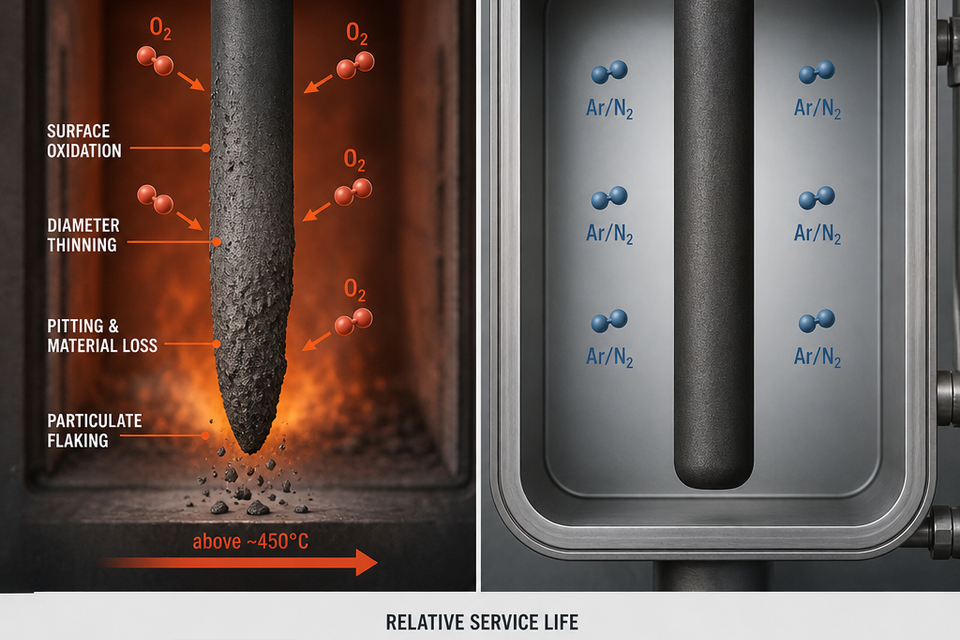
The operating atmosphere determines how long graphite rods last. In air, oxygen attacks the surface at high temperature, causing material loss that shortens service life. Under inert gas, the rod stays structurally intact. Define your service environment before selecting a graphite grade, because atmosphere is the first variable that changes the specification.
The rod’s atmosphere at temperature decides its service life more than its grade name does. Map the atmosphere and temperature profile first, then compare products against that map.
Step 1: Map every operating condition
- What: Record peak temperature, time at peak, heating and cooling rates, and every moment the rod touches oxygen.
- Why: Oxidation needs heat and oxygen together. A rod that spends hours at peak temperature in air can wear out faster than one that only briefly reaches the same temperature.
- How: Pull the furnace or process cycle log. Track warm-up, loading, and shutdown separately from the main run.
Step 2: Classify the service
- Air-exposed: Oxygen is present at temperature throughout.
- Inert-gas: The rod runs under nitrogen or argon.
- Vacuum: The rod runs at low pressure with little oxygen.
- Mixed: The rod sees air during loading, warm-up, or shutdown, then inert or vacuum conditions during the run.
Mixed service often drives the failure risk. A rod that sits hot while a chamber vents will oxidize, even if the process gas is clean.
Step 3: Set oxidation and life expectations per regime
- What: Ask for separate air and inert-gas temperature limits, plus expected service life at your peak temperature and duration.
- Why: One number hides the regime that matters. CM-03’s single 735℃ cutoff is a useful example point, but it does not tell you how that limit changes with atmosphere or hold time.
- How: Compare each candidate against your cycle log, not the datasheet headline. CM-04 operating limits need manufacturer confirmation before you compare them with CM-03.
Step 4: Treat conductivity as a process requirement
Conductivity comes from your circuit, current, and heating plan. It does not come from a catalog line. Specify the resistance range your process needs and the temperature where it must hold. Oxidation thins the rod over time, so test resistance after several cycles, not only at delivery.
Common mistakes to avoid
- Buying on grade name alone.
- Ignoring warm-up and shutdown air exposure.
- Quoting a peak temperature without the hold time.
Pro tip: Send your cycle log to the supplier and ask them to confirm, in writing, the suitable grade for each regime. That turns a vague spec into a quotable one.
Budget context
Listed CM-03 prices range from $5.55 to $288. Diameter, length, grade, machining, and order quantity drive the difference. Change one variable at a time in your quote request to see which one moves your cost.
Effort: Mapping and classification takes two to three hours if cycle logs exist. Supplier confirmation can take about a week.
Next step: Send your operating map to our team through the contact page. Then review matching options in our graphite electrode range.
Compare Grades by Oxidation Limit, Expected Service Life, and Conductivity Requirements
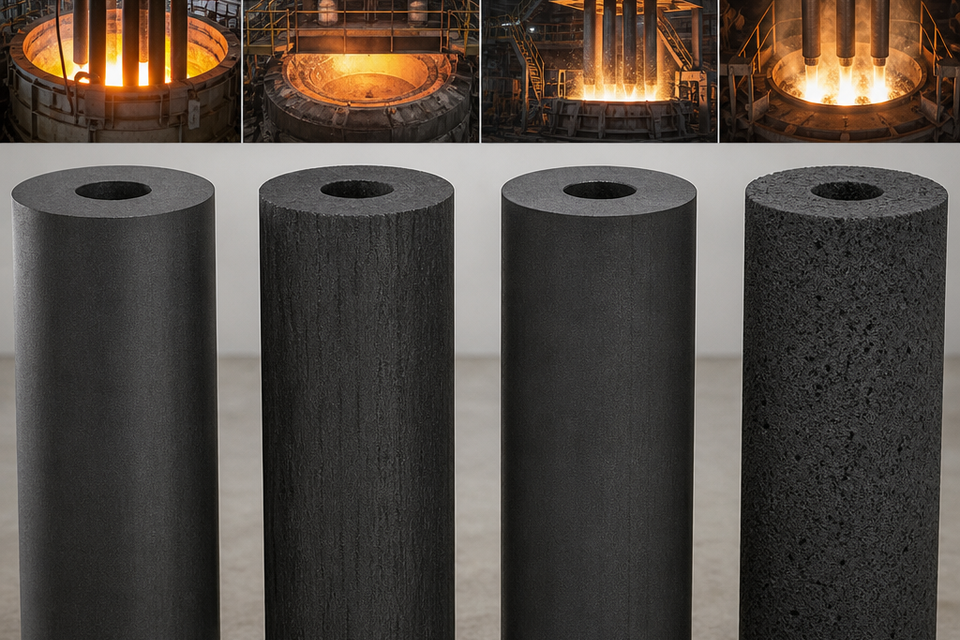
Higher-density, finer-grain grades generally tolerate higher oxidation temperatures and longer service life but cost more. Lower-resistivity grades suit high-current applications. Match the grade to your operating atmosphere, temperature, and current load rather than choosing on price alone.
Compare graphite rod grades on the attributes your process uses: air limit, inert-gas limit, service life at your duty cycle, and required resistivity. A catalog grade name tells you little about how a rod will perform in your furnace or cell.
Step 1: Build a side-by-side matrix
- What: One row per candidate grade, with columns for air-service limit, inert-service limit, expected service life, and resistivity.
- Why: A rod suited to inert atmosphere can oxidize fast in air. A single maximum temperature hides that gap.
- How: Fill each cell from the manufacturer’s written datasheet. Leave a cell empty if no source confirms the value.
Step 2: Demand the test basis for every number
- What: Ask for temperature, atmosphere, test duration, and sample size behind each figure.
- Why: A life figure from short tests in nitrogen cannot compare with one from long tests in air.
- How: Reject any number without all four details. Ask for life data at your operating temperature, not the catalog maximum.
Step 3: Treat published limits as unconfirmed
Some listings show one threshold of 735℃ for CM-04. Treat that figure as unconfirmed. Get the limit, atmosphere, and duration in writing before you specify the grade. Some buyers accept catalog numbers to speed up sourcing. However, a wrong limit shortens rod life and can stop production.
Step 4: Turn the price range into an RFQ checklist
The listed price range for CM-03 is wide, and this guide asserts no price figures. Use RFQs to find out what drives cost in your case.
| Price driver | RFQ field to request |
|---|---|
| Diameter | Nominal diameter and tolerance |
| Length | Cut length and tolerance |
| Grade | Grade code and datasheet revision |
| Machining | Drawing, end finish, tolerances |
| Order quantity | Unit price at three quantity breaks |
| Packaging | Crating or packing specification |
| Shipping | Incoterms and delivery location |
Record quotes side by side:
| Field | Supplier A | Supplier B | Supplier C |
|---|---|---|---|
| Grade code and datasheet revision | |||
| Air and inert limits (with test basis) | |||
| Service life (with test basis) | |||
| Resistivity and test method | |||
| Diameter, length, tolerance | |||
| Machining | |||
| Unit price at each quantity break | |||
| Packaging and shipping terms | |||
| Lead time and quote validity |
Common mistakes
- Comparing quotes for different diameters or lengths.
- Accepting resistivity values without a test method.
- Ignoring shipping and packaging when comparing totals.
Pro tip: Send the same drawing and datasheet request to every supplier. Collect at least three quotes on identical specs before you draw any cost conclusion. Expect this step to take a few days.
Ready to start? Review our graphite electrode range or request a quote with your specification.
Match Purity Grade to Process Sensitivity, Including When 99.95% Is the Right Choice
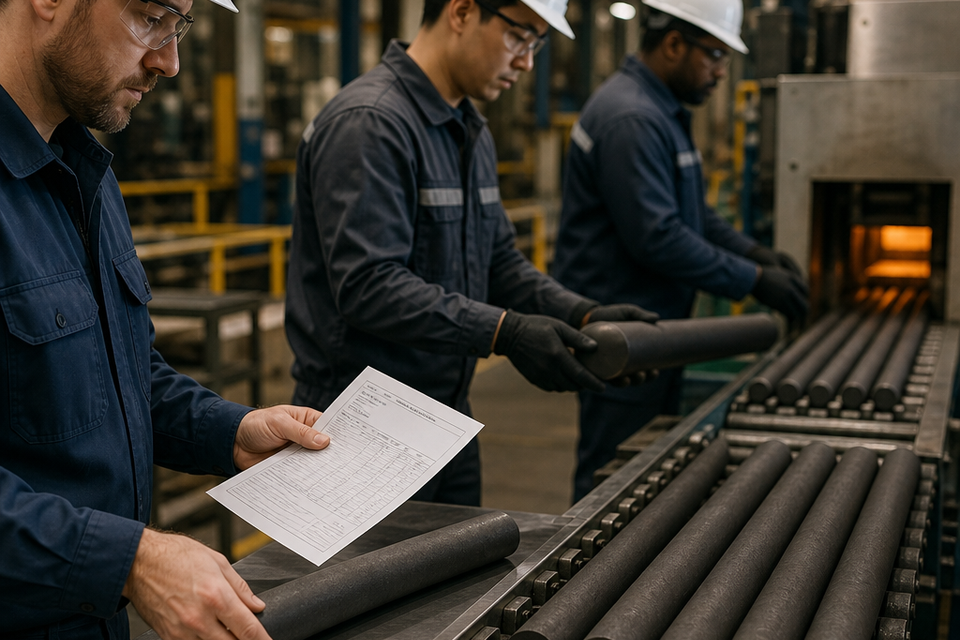
Start with the process’s contamination tolerance, not the price. 99.95% purity covers a wide middle band of applications, but only the CoA’s ash and trace-metal values confirm whether a specific rod meets your process limits.
Choose the lowest purity grade your process can tolerate. Move up only when a specific impurity can damage your product or shorten rod life. For many moderate-sensitivity processes, 99.95% is the right choice, as long as the supplier’s certificate of analysis (CoA) meets your limits.
Some buyers assume the highest grade is always the safer option. However, higher purity reduces specific contamination paths. It does not improve performance in every application, and it raises cost. For grade details, see the graphite electrode product page.
Illustrative scenario (hypothetical): An engineer specifies a fine-grained rod for an electrochemical fixture. The process tolerates modest ash, but the fixture needs a close diameter and length fit. The engineer must set grade and dimensions together.
Steps:
- Set the impurity limit. Ask the process owner which elements or ash levels affect output. Write the number down. Expect one to two days. Mistake to avoid: requesting “high purity” with no limit attached.
- Check the CoA against the limit. Compare each candidate’s CoA with your process specification. Do not decide on the grade name alone. Expect a few hours per candidate.
- Confirm dimensions before machining. Tight fits raise the chance of chipping during machining, so confirm achievable diameter, length, and tolerance early. In this hypothetical, the engineer sends drawings through the contact page before freezing the design.
- Plan handling. Control heating and cooling rates to limit thermal shock. Keep rods sealed and clean to limit dust contamination.
- Build lead time and export into the schedule. Add sample approval and export transit to the timeline. Get lead times in writing from the supplier. Pro tip: a sample run before the full order catches fit problems while they are cheap to fix.
Decision table (general criteria):
| Process sensitivity | Impurity tolerance | Where to start |
|---|---|---|
| Low: ash and trace elements do not affect output | Wide | 99.95% grade, if CoA limits are met |
| Moderate: some trace elements matter | Narrow | 99.95% only if CoA values clear your limit |
| High: trace contamination affects product or rod life | Very narrow | Evaluate 99.997%, verified by CoA |
Price rises with purity, diameter, length, machining, and order quantity. Request quotes for each option so you compare total cost, not just grade. Expect the quote and lead-time review to take about one week.
Confirm Density, Grain Size, Dimensions, and Machinability Before Requesting a Design-Fit Quote
Before you send a drawing, confirm four things in writing: density and grain size as design requirements, achievable tolerances with diameter and length ranges, recommended machining practice, and a lead time with an export timeline. “Machinable” on a catalog page does not tell you whether a part will fit.
Illustrative scenario: This is a hypothetical. An engineer needs a fine-grained graphite rod for an electrochemical fixture. The rod seats in a bore with a tight fit, and the fixture has a fixed install date. Here is how she would work through it.
Step 1: Write density and grain size as requirements (about 30 minutes)
- What: Put a minimum density and a grain size range on the drawing, not just a grade name.
- Why: Density and grain size affect strength, machining behavior, oxidation, and the surface finish you can hold.
- How: Ask the supplier which test method they use and whether values are reported per lot or per batch.
Step 2: Request achievable tolerances and size ranges (1-2 days)
- What: Ask for the diameter and straightness tolerances the supplier holds, plus the minimum and maximum diameter and length they produce.
- Why: Stock sizes often miss a fit that a fixture needs.
- How: Mark your critical dimensions on the drawing. Ask whether each one is held as-machined or after finishing.
Step 3: Plan machining to avoid chipping
Graphite is brittle, so the design affects how the part machines. Ask for recommended feed rates, tool geometry, and edge chamfers. Avoid thin walls and sharp internal corners.
Common mistake: Specifying a tight wall tolerance on a section too thin to hold it through machining.
Step 4: Limit thermal shock and dust
Store rods dry in sealed packaging. Do not move them from cold storage straight into a hot furnace area. Clean dust before assembly, because particles can contaminate electrochemical cells. Also specify purity here. Trace ash affects electrochemical performance, so 99.95% and 99.997% are not interchangeable for every fixture.
Step 5: Build lead time and export into the schedule
In the illustrative case, the timeline runs like this:
- Weeks 1-2: drawing and spec review
- Week 3: supplier confirms tolerances and lead time
- Weeks 4-6: machining and inspection
- Then: export booking and transit
Add buffer for a re-quote if a first sample misses a dimension.
Pricing context
The CM-03 price range of $5.55 to $288 reflects diameter, length, grade, machining, and order quantity. Request quotes at two quantities so you can see how volume changes unit cost. Machined-to-size parts usually cost more than stock rods, so decide early which operations you need.
Pro tip: Send one drawing with all critical dimensions marked, and ask for tolerance and lead-time confirmation in the same reply. Contact our team through the contact page to start that review, and browse grade options on the graphite electrode page.
Build a Verifiable Cost Model From Price Drivers Instead of Relying on Catalog Ranges
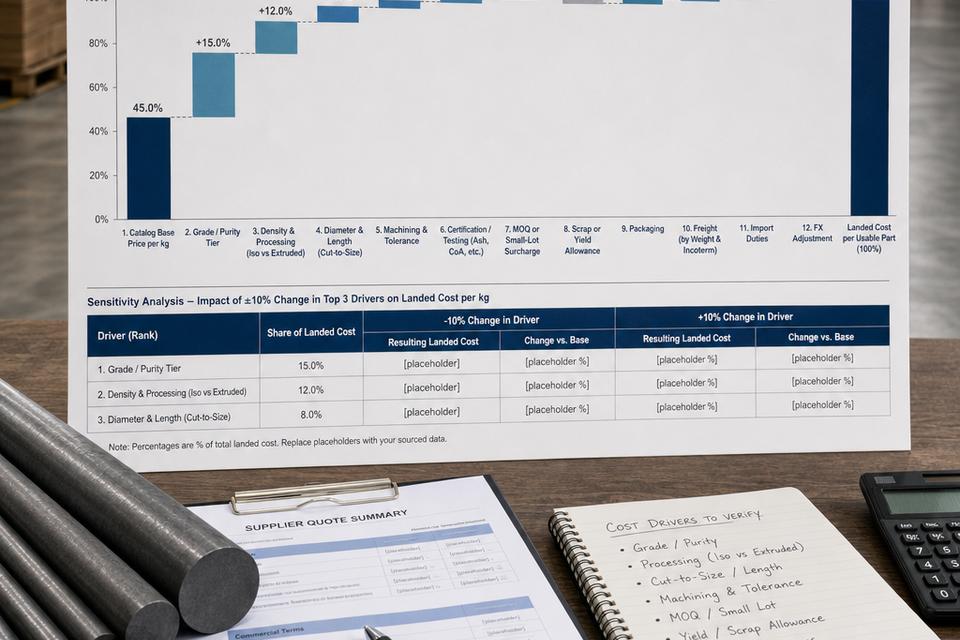
Catalog prices show only the starting point. The landed cost of graphite rods is driven by grade, processing, order size, yield loss, and logistics. Model each driver separately so you can verify the total and see which inputs to negotiate first.
Catalog price ranges show a spread, not a budget. Build your cost model by tying each price driver to one RFQ field, then compare quotes written against the same spec. Only then does a price gap tell you something.
Step 1: Lock the spec before requesting prices.
- What: Fix diameter, length, grade, purity, density, grain size, and tolerance class in one document.
- Why: A quote for a different diameter or tolerance is not comparable.
- How: Send the same spec sheet to every supplier, and log its version number.
Step 2: Map each driver to an RFQ field.
| Price driver | RFQ field | What to state |
|---|---|---|
| Diameter | Outside diameter and tolerance | Exact size and allowed deviation |
| Length | Overall length | One length or cut-to lengths |
| Grade | Named grade and service conditions | Specific grade, not “graphite” |
| Purity | Impurity or ash limit | Percentage and test method |
| Density, grain size | Target values | Value and allowed range |
| Machining | Operations and tolerance class | Cutting, drilling, threading |
| Order quantity | Quantity per release | Total volume and release schedule |
| Packaging | Packing method | Protection for each rod, export crate |
| Shipping terms | Incoterm and destination | Named Incoterm and port or address |
Step 3: Record quotes side by side.
| Supplier | Quote date | Spec version | Unit price | MOQ | Machining charge | Packaging | Incoterm | Lead time (weeks) |
|---|
Request each quote at two order quantities. Some suppliers price breaks by volume, and the second quantity shows you the curve.
Illustrative scenario: An engineer specifies a fine-grained rod for an electrochemical fixture with tight diameter limits. Two suppliers quote a lower unit price, but one quote uses a looser tolerance class and the other excludes machining. The engineer adds machining cost and rejects the looser tolerance. The lower quote ends up costing more per usable part. The engineer also adds export transit time to the project plan before setting the install date.
Common mistakes:
- Comparing rod prices when machining is excluded from one quote.
- Ignoring Incoterms, which move freight and duty costs.
- Treating a scrap allowance as zero.
Pro tip: Compare cost per usable part, not cost per rod. If machining scrap is 10% in your own trial (a hypothetical figure you must measure), that loss raises the effective price of every good part.
Effort: Expect 2-3 hours to build the spec and template. Quote collection often takes 2-4 weeks, depending on supplier response times.
Before you finalize tolerance or lead-time assumptions, confirm them with our team. For grade and product options, review the graphite electrode range.
Control Handling, Storage, and Failure Modes: Thermal Shock, Oxidation Loss, Dust, and Storage
Most graphite rod failures come from handling, heating, and storage, not from the grade name alone. Control those three factors and the rod lasts longer in service.
Failure modes and controls
| Failure mode | Typical sign | Control measure |
|---|---|---|
| Thermal shock | Cracks or chips after fast heating or cooling | Set a ramp rate, preheat evenly, and never load a cold rod into a hot zone |
| Oxidation loss | Surface wear and diameter loss at temperature | Match the atmosphere to the grade’s limit, and use inert gas above the air limit |
| Mechanical damage | Edge chipping during machining or handling | Support the full length, use sharp tools, and pad storage racks |
| Dust contamination | Fine particles on contacts or in the process | Clean the bench, bag rods, and wipe them before installation |
| Moisture uptake | Outgassing or shifts in electrical behavior on first heat | Store sealed and dry, and dry the rod before first heating |
Some grade pages cite a single temperature cutoff. For example, one listed grade carries a 735℃ figure. That number applies to one atmosphere, so confirm the limit for your own furnace conditions.
Illustrative scenario: a fine-grained rod for a tight-fit fixture
This is a hypothetical. An engineer must specify a fine-grained rod for a furnace fixture with tight diameter limits.
- Confirm tolerances and size ranges first. Send the drawing with diameter, length, and tolerance before you finalize the spec. Confirm what tolerance the supplier holds on your part via the contact page. Don’t assume a catalog range covers your dimensions.
- Plan machining to avoid chipping. Specify a roughing pass and a light finish pass. Request edge chamfers, because sharp edges chip first.
- Limit thermal shock and dust on arrival. Store rods dry and sealed. Wipe each rod before loading, and ramp heat slowly.
- Build lead time and export time into the schedule. Add buffer for machining, customs, and transit. Get written lead-time confirmation before you lock the furnace install date.
Pricing context
Price depends on diameter, length, grade, machining, and order quantity. Tight tolerances and custom machining raise cost. The CM-03 price range of $5.55 to $288 reflects that spread across different specs. Request a quote against your exact drawing from the graphite electrode product page.
Some teams skip dry storage to save time. However, a sealed bag costs far less than replacing a cracked rod mid-run.
Real-World Graphite Rod Selection Challenges and Solut
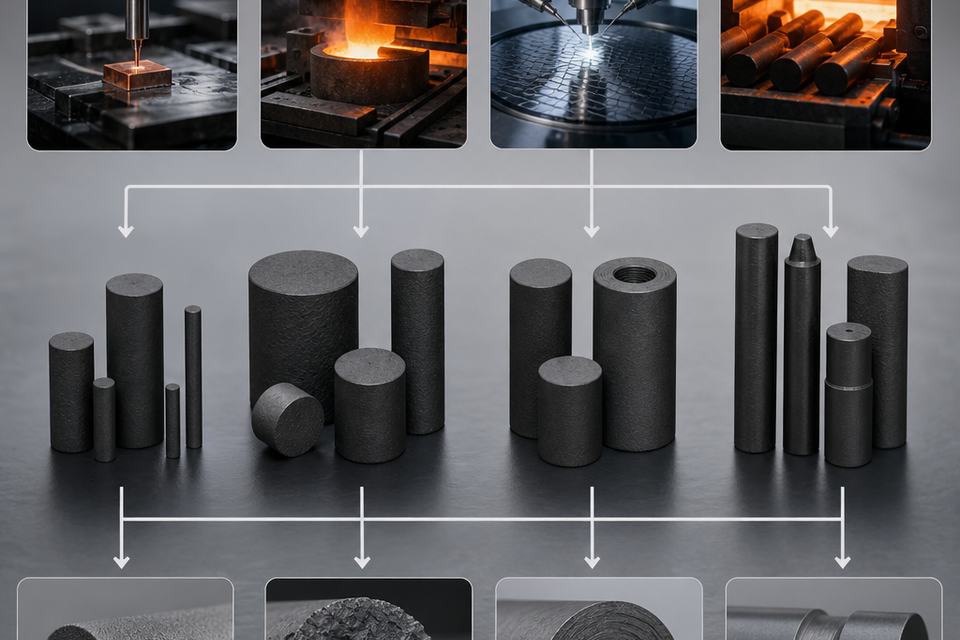
Matching grain size, strength, purity, and dimensions to your application prevents the most common graphite rod failures. Use this flow to translate a process problem into a specification before you request quotes.
The fastest way to avoid a failed fixture is to get the supplier to confirm tolerances, size ranges, and lead time in writing before you finalize the drawing. Most rework comes from specs the supplier never agreed to produce.
Illustrative scenario: A hypothetical engineer specifies a fine-grained graphite rod for an electrochemical fixture. The drawing calls for a tight diameter and a long, slender length.
- **Confirm achievable tolerances and ranges.**What: Send the drawing and ask for written confirmation of diameter, length, and tolerance limits for the grade.Why: A tolerance that looks ordinary on paper may be hard to hold on a given grade.How: Request confirmation through the contact page before ordering.
- **Plan machining to avoid chipping.**What: Set up light cuts, sharp tooling, and chamfered edges.Why: Graphite chips at edges and corners, and chips can ruin a fit.How: Chamfer edges on the drawing instead of specifying sharp corners.
- **Handle the rod to limit thermal shock and dust.**What: Store rods in clean, sealed packaging. Let them reach shop temperature before heating.Why: Sudden temperature changes can crack rods. Loose dust can contaminate electrochemical surfaces.How: Bag and label each rod. Clean the workspace before assembly.
- **Build lead time and export into the schedule.**What: Add confirmation, production, inspection, and shipping as separate milestones.Why: Export paperwork and transit often take longer than production.How: Ask for lead time per milestone and add buffer before the fixture build date.
Some engineers specify the tightest tolerance to guarantee fit. However, tighter tolerances raise machining time and scrap risk. Loosen any tolerance the fixture allows.
Price context: Cost depends on diameter, length, grade, machining, and order quantity. Prototype pricing rarely matches production pricing, so request an itemized quote for each.
Common mistakes:
- Choosing a purity grade without a process reason.
- Skipping machining allowance on the drawing.
- Ordering before the supplier confirms the spec.
Time required: Expect one to two hours for the spec review and quote request, plus supplier lead time.
Conclusion
Selecting a graphite rod works best when you move in order: define the atmosphere and temperature profile first, then compare grades on oxidation behavior, conductivity, and purity that your process actually needs. Dimensions, machinability, and a clear cost model come next, and handling and storage controls protect the investment once the rod is in service. Treat every catalog number as a claim to verify, and ask suppliers for the test basis behind it.
A practical next step is to write a one-page process envelope and a basic RFQ template using the fields covered above, then request quotes from at least three suppliers on the same basis. For grade-specific details, review the graphite electrode product page at https://www.zgtdts.com/products/graphite-electrode/. If you need process-specific validation of tolerances, impurity limits, or lead times, reach out through https://www.zgtdts.com/contact-us/ before you finalize the spec.
Post time: 11-25-2026